
The pinnacle of the sport of boxing was showcased in the early hours of Sunday morning, as Mexican legend Saul “Canelo” Alvarez squared off against Englishman Billy Joe Saunders, in one of the most anticipated boxing fights in modern boxing history. The fight’s stakes couldn’t be any higher: Canelo’s pledge to unify the Super-Middleweight division lined up an exciting encounter against Saunders, who held the WBO title prior to their showdown. And whilst Canelo Alvarez had already captured multiple world titles in four weight divisions and held three of the five major titles in Super-Middleweight previous to the Saunders fight, the Mexican looked as motivated as ever to capture another belt for his ever-growing collection. Saunders’ undefeated record prior to the fight was justification for many to deem the future fight a close encounter, with his technical boxing ability, amateur acumen and fancy footwork fuelling much of the punditry leading up to the fight. Furthermore, Saunders’ familiarity with big fights perhaps elevated his justification for a showdown against Alvarez, with his wins against World Champions Andy Lee, Chris Eubank Jr, David Lemieux and Martin Murray compiling his impressive fight CV. Importantly, these victories came within the context of hostile environments, which was a reasonable expectation for Saunders when he agreed to fight Mexican born Alvarez in the middle of the Cinco De Mayo festival, and in the Mexican stronghold of Texas. As hostility for Saunders was a sure thing, so too was the fact that Canelo represented his biggest test to date: Alvarez is considered by many as the Pound-for-Pound best boxer in the world, and sports a uniquely impressive boxing record against some of the greatest boxing competitors of all time, in multiple weight divisions.
The bout served, as billed, as a closely contested stylistic matchup of Power Vs Technical Ability (or Cat Vs Mouse) to the delight of the record breaking 73,126 people in attendance. Throughout the fight, Billy Joe Saunders tentatively attempted to outscore his opponent with a jab heavy offense, with the Englishman tiptoeing in and out of the range of Canelo’s dangerous power punches. Billy Joe Saunders looked to be scoring effectively with his strategy, which seemed to restrict his opponent’s grounding in the fight. Whilst Saunders seemed to be winning the majority of rounds, Canelo remained composed, unphased, and determined in his approach, and seemed comfortable in attempting to counterpunch the Englishman. Canelo’s overall offensive output was looking to be of a lesser volume than his adversary’s (which is quite typical for Canelo), but it was clear that he was landing the more impactful punches. Such a happening in boxing often casts doubt in judging and officiating: Does Saunders win the round because he’s landing more punches, or does Canelo win the round because he’s landing the harder strikes? This scenario took up much of the dialogue on the broadcast, with the broadcast team split on who they thought was winning the fight throughout. But disaster struck in Round 8 for Billy Joe Saunders: True to form, the world class Alvarez upped his output and landed a series of undeniable body and head strikes, which forced Saunders to adopt a more defensive approach. As Canelo’s strikes were coming thick and fast, Saunders was struck with a heavy left uppercut, which seemed to swell his right eye instantly. The noise of the shot bellowed across the AT&T Stadium, as Canelo looked on, through a gritted smile. Like a shark to blood, Canelo looked to finish the fight there and then, and riled up his adoring fans by waving his arm, verbally taunting Saunders and throwing vicious body and head strikes (the majority of which landed effectively). As the round ended, Canelo’s fans launched into hysterics, whilst Billy Joe Saunders miraculously walked unassisted to his corner. It was clear the bout’s momentum had shifted, and the compromised Billy Joe would do well to come out of his corner and continue to fight.
But what happened next would fuel the public discourse of the fight, and the world class boxing performances from both fighters would merely elapse into a forgotten memory: Intense discussions seemed to be ongoing in the Saunders corner, with the Englishman appearing to be dejected and deflated. His right eye, completely swollen shut, seemed to be getting worse by the second, as his cornermen scrambled to attend to it hastily. Discussions between Billy Joe Saunders and his coach Mark Tibbs appeared grave, and concluded with Tibbs waving the bout off. As Tibbs signalled that his fighter was unable to continue, the Canelo Alvarez corner celebrated and gestured triumphantly to the delighted crowd. Alvarez positioned himself inside the ring after the fight to address his emotional fans in his native tongue, whilst Saunders looked to exit hastily due to growing medical concerns regarding his injuries. As Canelo then made his way to a celebratory press conference, Billy Joe Saunders was transported by ambulance directly to a Texas hospital to undergo immediate (and emergency) surgery. Promoter Eddie Hearn reported that Saunders suffered “multiple facial and eye fractures” and cornerman Mark Tibbs purported that “his eye socket was caved in”, which conveys the extent of the undeniable damage done to the face of Billy Joe Saunders. But whilst many educated fans of boxing recognised the perilous position Billy Joe Saunders found himself in, and acknowledged the cohesive mechanism to which a corner deems their fighter unable to continue, there remained an unapathetic response to the plight of Billy Joe Saunders, who suffered potentially life altering injuries in the name of spectator driven sport.
In response to the conclusion to the fight, the label “quitter” has been mercilessly attached to Billy Joe Saunders (mostly on social media and mostly by spectators), to the horror of some industry experts within the boxing community. The implication of such a comment suggests that Billy Joe Saunders could have continued on in the fight and fought through his injuries (despite the unquestionable severity of them). Either deliberately or carelessly, the DAZN broadcast team commented that Billy Joe Saunders “quit on the stool”, which has fuelled what Promoter Eddie Hearn has referred to as the false “quitter syndrome” narrative attached to Saunders. Experienced boxing coach Jamie Moore praised the decision of the Saunders corner to stop the fight, calling the fight retirement “an educated and informed decision” by Saunders’ trainers. Similar to many of his fellow boxing aficionados, Moore voiced disgust at the accusation that Saunders simply “quit on the stool”, saying “you can’t even imagine what would have happened if he was sent in for the ninth round”. Similarly, Eddie Hearn defended Saunders, stating “firstly, his trainer pulled him out of the fight” and praised the Englishman’s heart by saying “he didn’t take a knee and he didn’t turn his back, he stayed in there”. The comments made by both Hearn and Moore have a similar gravitas: They acknowledge that Saunders’ medical condition was grave, and the correct decision was made to stop the fight. Their comments also allude to the fact that Billy Joe Saunders himself did not simply refuse to fight anymore, and that his corner were the chief decision-makers in this moment. This has been backed up by Billy Joe’s head coach Mark Tibbs’ retelling of this moment, who reiterated that he was the one that decided to stop the fight.
Whilst the disrespectful tone to much of the discourse surrounding the stoppage of the fight is perhaps the result of Billy Joe Saunders’ prior indiscretions, the narrative that fighters should be expected to fight through life altering injuries is unquestionably dangerous. One of the most vocal critics of the Billy Joe Saunders stoppage was his former opponent Chris Eubank Jr, who posted a video directly prior to the fight. Eubank Jr is heard saying “he wants to go home!”, whilst uncontrollably laughing at the Englishman. Whilst Eubank Jr’s video should be viewed from the perspective that Eubank Jr has eagerly called for a matchup with Saunders (and this may simply be a tactic to bait Saunders into accepting his proposal) it should be noted that fighter safety protocols have a vital placement in boxing, and should be implemented when required. With many unfortunate deaths, serious injuries and life altering events occurring in the sport of boxing, the spirit of such comments (and actions) made by Eubank Jr perhaps oversimplifies a complex issue within the sport, and dilutes the discourse surrounding fighter stoppages. Eubank Jr has experienced first-hand the cruel dangers of boxing: His former opponent Nick Blackwell suffered bleeding to the brain as a result of their bout in 2016. Blackwell’s life was saved by a bout stoppage in the 10th round, initiated by the referee and finalised by the in-ring doctor. As the fight concluded, Blackwell was rushed to hospital and was induced into a medical coma to treat his injuries. Whilst it would come to pass that Nick Blackwell would never box professionally again, his life was saved by the medical safeguarding implemented by the referee and in-ring doctor. In such circumstances, time is a precious commodity, and it’s not known whether Blackwell’s wellbeing could have been saved if this stoppage had not occurred when it did.
Simply put, the “sporting” aspect of “combat sports” refers to the competitive nature of the event, and should not imply a time-based triviality to it. Whilst there are winners and losers, the implications of combat competition routinely outlive the duration of the individual bout, with medical and psychological consequences affecting competitors many years after their careers. At a minimum and as a token of gratitude, fighters deserve adulation for their sacrifices inside the completive sphere by the spectators that consume their product, regardless of how successful they are in their pursuit of victory. To criticize the heart of a beaten fighter without ever experiencing that hardship is crass, ignorant and lacks validity. Furthermore, the anti-stoppage rhetoric implied by such comments convey combat competition as displays of barbaric bloodsport, and should be discouraged by those that know better, for the sake of the fighters that deserve better treatment. As an acknowledgement to the unfortunate deaths and injuries that have previously occurred within combat sports (as well as similar events that will most definitely happen in future), stoppages should be accepted as part and parcel of the sport, not ridiculed. By virtue of stepping through those ropes or stepping into a cage, respect should be given to those who deserve it. And by anyone’s measurement, fighters undoubtedly do that.

UPPERCUT: Canelo lands the most decisive blow of the contest, rendering Saunders obsolete. 
WARRIOR: Saunders attempts to find his bearings and continue on. 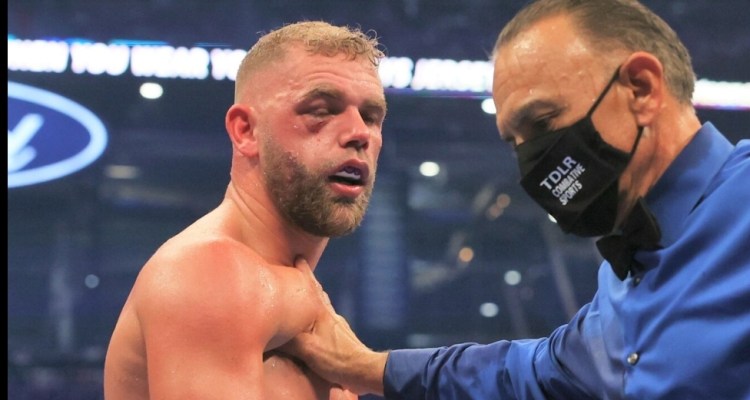
REALITY: Saunders winching in agonising pain, as the referee separates the fighters. 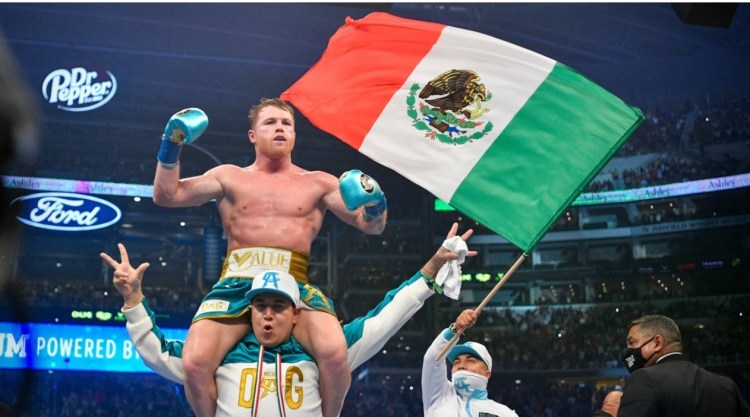
WINNER: Canelo Alvarez captures the WBO Super-Middleweight Title in dramatic fashion. 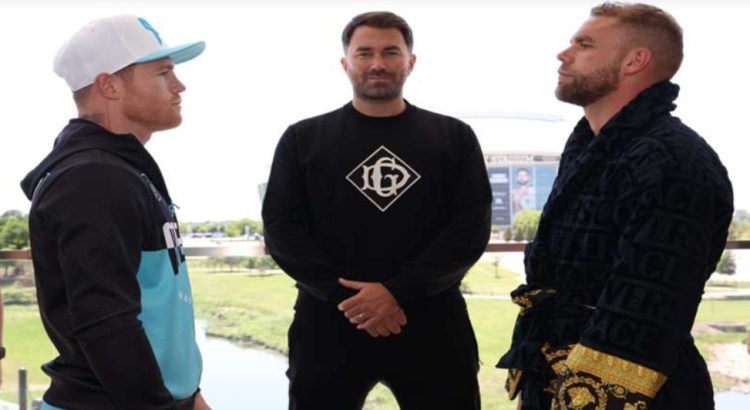
STAREDOWN: Promoter Eddie Hearn steps between Saunders and Alvarez. 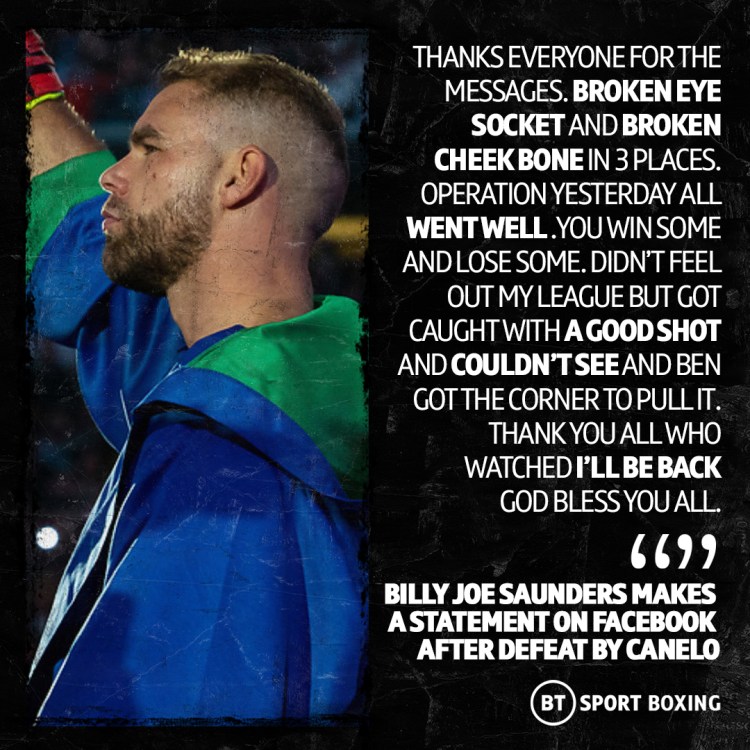
STATEMENT: Saunders issues a statement post-fight. 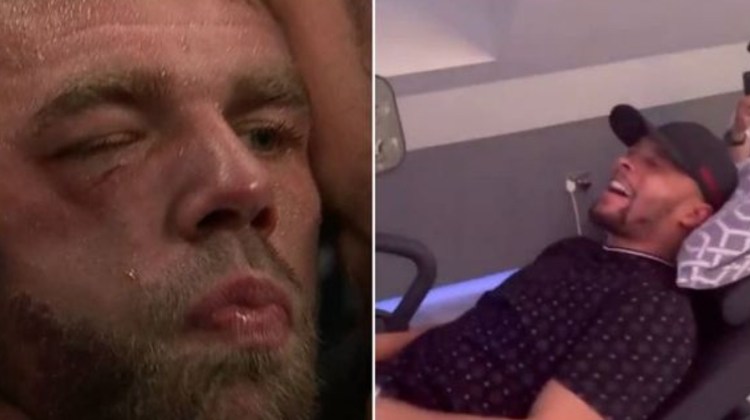
QUITTERGATE: Eubank Jr jeers rival (and former opponent) Billy Joe Saunders from afar, as the bout is stopped.
 Conflict Collective