
When viewing a sport, the pathway to victory is usually obvious. Most field sports rely on superior scoring to dictate the winner of a contest, which largely eliminates debate surrounding the rightful winner. But when it comes to combat sports, the judging aspect of a fight that goes to a decision often causes controversy, particularly in fights which are deemed “close”. But more often than not, it’s lack of understanding by the viewer (and shockingly, members of the sport) that causes the controversy, and not the agreed terms of the fight.
In order to improve overall understanding of the sport, MMA has a job to do to convey how straightforward MMA judging is. For a start, there exists a document in which judges must consult in order to inform their judging: “The Unified Rules of MMA” document by the “Association of Boxing Commissions” (or ABC, as their commonly known). This document is the ‘be all and end all’ for the perception of winning or losing a fight, and until this document is amended or replaced, provides the basis for all aspects of MMA judging (and the rules). The document eliminates subjectivity and attempts to avoid preferential scoring based on subjective admiration for a particular technique, which evens the playing field for all MMA practitioners to implement their own style and claim victory. And whilst a “10-Point Must Scoring System” implies that the winner of a round scores ten points and the loser of a round scores nine points, the clear and defined nature of the pathway to such eventualities is also underpinned by the possibility that scoring can differ from this model, but very rarely.
The document itself is very easy to find, and aspects of the document can be seen on UFC broadcasts. But what’s not carried by the UFC (or indeed, many MMA organisations) is the simplistic nature of how a fight is scored. The judging criteria is based upon a three tiered system, that only becomes three tiered if the first and second tiers are not realised. Crucially, Tier One details “Effective Striking/Grappling”, Tier Two details “Effective Aggressiveness” and Tier Three details “Fighter Area Control”, but most fights are scored only on Tier One (as there is usually a clear winner within this criteria). The Tiered system can be viewed below:
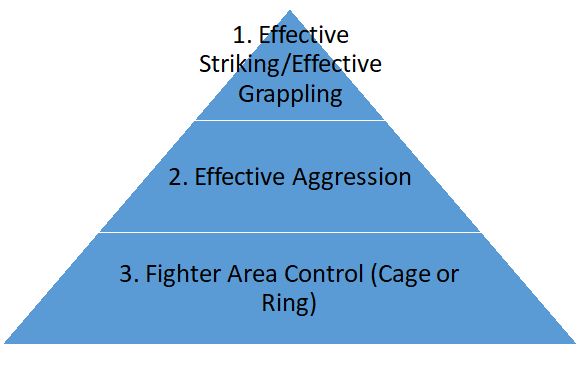
The only difficulty with creating such a straight-forward system is in the implementation; Judging and officiating are heavily scrutinised in most sports, often due to the subjective nature of how their rulings are interpreted within a contest. Rightly or wrongly so, scrutinising decisions made by officials is embedded into the DNA of most sports, and MMA is no exception. Vocal criticisms of MMA judging has become a staple of the discourse of the sport (from grassroots to the UFC) which actually led to this MMA judging criteria rollout in 2016. But when this scrutiny is plainly contextualised on an incorrect perception of the terms of the bout, it should be called out as such. Likewise, when broadcasters on MMA events perpetuate incorrect analysis on round scoring (using terms like “cage control” and “aggression” to underpin their belief on who won a specific round, rather than assessing who is most effective within striking or grappling exchanges), this needs corrected. This behaviour promotes an incorrect perception of the sport, sets audiences back within their basic understanding of the sport and has the potential to cast doubt over a fighter’s win (or loss), which fundamentally dictates the trajectory of their career. And unfortunately, these behaviours continue to happen many years after the implementation of the MMA judging criteria.
Since the inception of the MMA judging criteria in 2016, MMA Pioneer ‘Big’ John McCarthy has been vocal in its implementation, and his video outlining the terms of this serve as an informative and easy to digest guide to MMA judging (as well as the rules of MMA, which are also explained in the video). His video highlights the key aspects of the tiered scoring system, as well as the differences between round scores (a round that’s scored 10-9 versus a round scored 10-8, and so on). McCarthy summarises how a fight should be perceived by fans and judges, noting that “there are only two elements of the fight; The striking and the grappling”, and implies that to win a round is to win either (or both) facets, depending on how the round takes place (either through mostly grappling exchanges or mostly striking exchanges). His basis for evaluating whether a fighter is displaying “effective striking” or “effective grappling” is directed by the impact each fighter is having in their exchanges, with the most impactful fighter being deemed the winner of the round. Denoting some widely held misconceptions (which is the basis of the MMA judging criteria in the first place) McCarthy concludes that judges should not bring aggression or fighter area control (Tier One and Tier Two) into play “unless you believe the others are completely evenly scored”, and a measure of how effective a fighter is within the striking or grappling exchanges is by how impactful a fighter has been to potentially ending the fight.
Whilst many resources outlining the MMA judging criteria exist, it’s clear many people are not aware of the intricate details of the implications of MMA scoring. Routinely, fighters and fans will vocalise their disagreements with MMA judging, but their reasoning does not match the terms of the judging criteria. Curiously this has also been the case with some MMA broadcasters, who portray an incorrect analysis on judging (or round by round scoring). The power of such analysis has led to contests being routinely perceived as being closer than they were, or even being deemed as a display of incorrect judging. As such, it’s important to eliminate bias and incorrect interpretation of the rules of MMA, and routinely revising the resources available (the MMA judging criteria and ‘Big’ John McCarthy’s breakdown are two notable examples) to keep yourself informed.
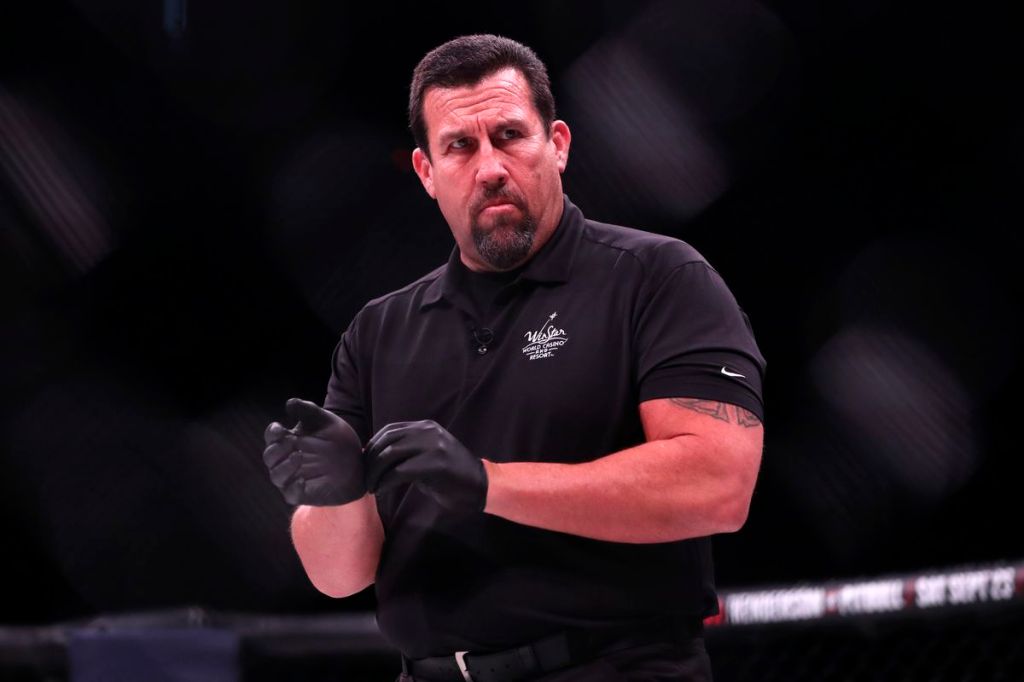
VOCAL: ‘Big’ John McCarthy has clarified upon MMA judging criteria (and rules) since their inception in 2016. 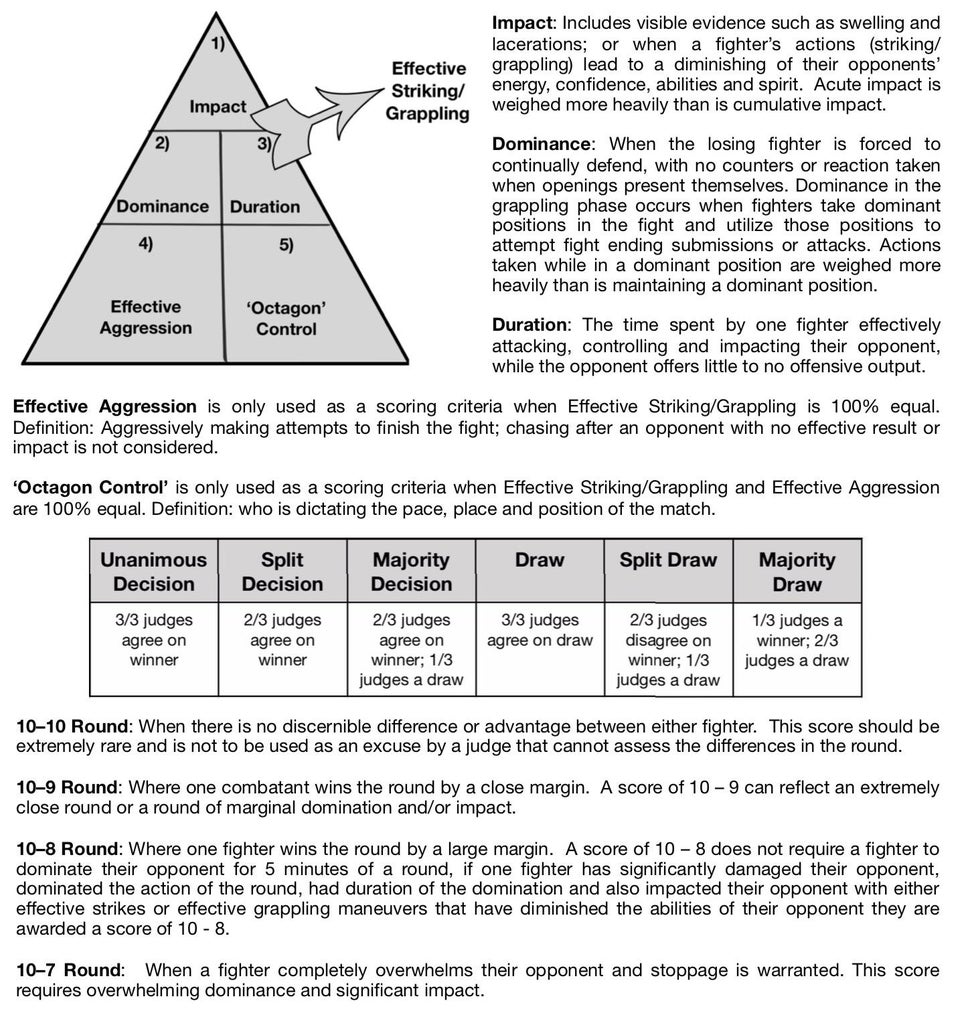
GUIDANCE: Reddit User “Pmosure” is an active and licensed MMA judge under John McCarthy’s “COMMAND” programme, and has highlighted some points with regards to quantifying the variables of MMA judging. 
JUDGING: MMA judging has become a scrutinised practice since the beginning of the sport, but criteria changes have made judging more straightforward and less open to interpretation.
 Conflict Collective